

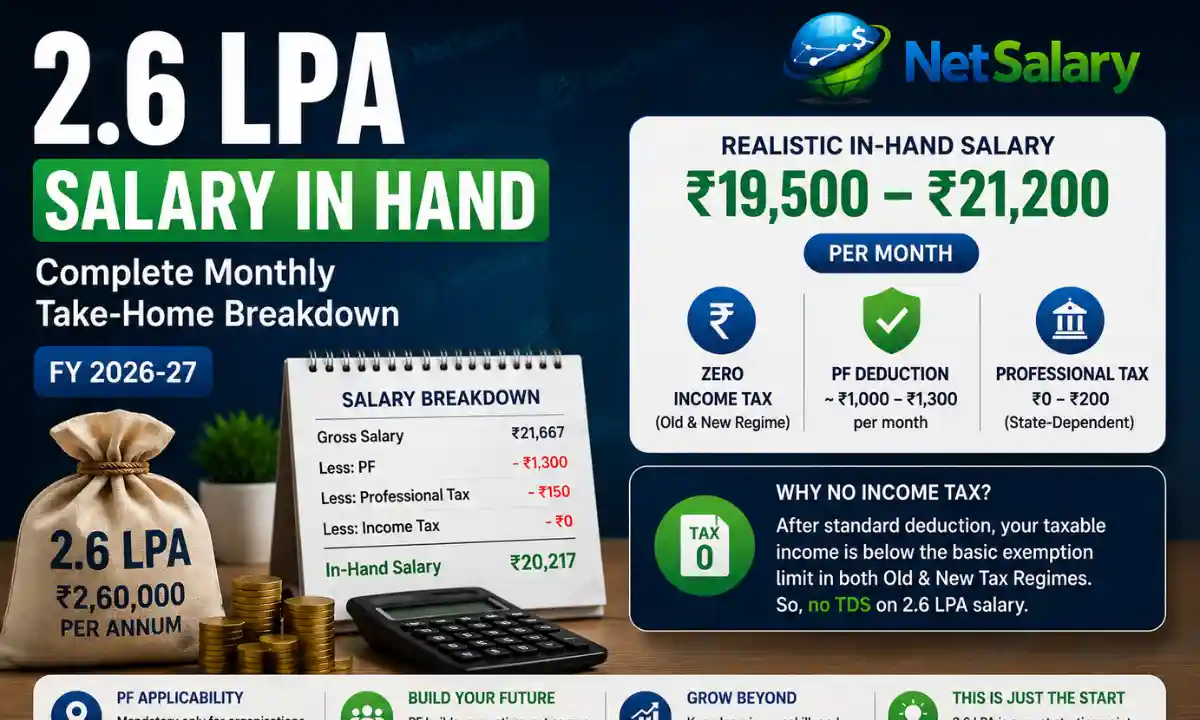
If your offer letter says 2.6 LPA (₹2,60,000 per annum), your realistic in-hand salary works out to roughly ₹19,500 to ₹21,200 per month, depending on your company’s salary structure, your state’s professional tax rules, and whether Provident Fund (PF) is applicable. There is zero income tax on a 2.6 LPA salary under both the Old and New Tax Regimes, since this income falls well below the effective taxable threshold after the standard deduction.
This article breaks down “2.6 LPA Salary In Hand” exactly how that number is calculated, what gets deducted, how it compares across cities, and how you can grow beyond this starting salary.
What Does “2.6 LPA” Actually Mean?
LPA stands for “Lakhs Per Annum.” So 2.6 LPA simply means your total annual package is ₹2,60,000. Companies almost always quote salaries as CTC (Cost to Company) – the full amount the employer spends on you in a year, not the amount that lands in your bank account.
CTC includes several things that never touch your monthly bank balance:
- Employer’s contribution to your Provident Fund
- Gratuity provision
- Group insurance premiums (if any)
- Annual bonus components (paid once a year, not monthly)
This is exactly why freshers are often confused or disappointed when their first salary credit is noticeably lower than “2,60,000 ÷ 12.”
Gross Monthly Salary (Before Any Deductions)
The simplest math first:
₹2,60,000 (Annual CTC) ÷ 12 months = ₹21,667 per month (Gross)
This ₹21,667 is your gross monthly salary – the figure before PF, professional tax, or any other deduction is applied. Your actual in-hand salary will be a little lower than this.
Typical Salary Structure for a 2.6 LPA Package
Indian companies usually break CTC into multiple components. Here’s how a standard 2.6 LPA package is typically structured:
| Salary Component | Approximate Monthly Amount |
|---|---|
| Basic Salary (≈50% of CTC) | ₹10,833 |
| House Rent Allowance (HRA) | ₹5,417 |
| Special Allowance / Other Allowances | ₹4,300 |
| Employer PF Contribution (12% of Basic) | ₹1,300 (part of CTC, not paid to you directly) |
| Gratuity Provision | ~₹520 (part of CTC, paid only after 5 years of service) |
| Gross Monthly Salary | ₹21,667 |
Note: exact percentages vary by company. Some organisations don’t split Basic/HRA at all for entry-level roles and simply pay a consolidated/fixed monthly salary, especially in small firms, retail, or contractual/internship roles.
Deductions From a 2.6 LPA Salary
1. Income Tax – Usually ₹0
This is the biggest relief at this income level. Here’s why:
| Tax Regime | Basic Exemption Limit | Standard Deduction | Taxable Income on ₹2,60,000 CTC | Tax Payable |
|---|---|---|---|---|
| New Tax Regime (default since FY 2024-25) | ₹3,00,000 | ₹75,000 | ₹1,85,000 (well below exemption limit) | ₹0 |
| Old Tax Regime | ₹2,50,000 | ₹50,000 | ₹2,10,000 (below exemption limit) | ₹0 |
Since your effective taxable income after the standard deduction is below the basic exemption limit in both regimes, no TDS (Tax Deducted at Source) is cut from your salary at all. Choosing between the Old and New Regime makes no practical tax difference at this income level.
2. Employee Provident Fund (EPF) – Around ₹1,000 to ₹1,300/month
- EPF is deducted at 12% of Basic Salary.
- It is mandatory only for organisations with 20 or more employees, as per EPFO rules.
- Many small companies, startups, and firms with fewer employees don’t deduct PF at all for entry-level or contractual staff, in which case your in-hand salary will be closer to the gross figure.
- If PF is applicable: 12% of ₹10,833 (Basic) ≈ ₹1,300/month goes into your EPF account (this builds your retirement corpus and isn’t “lost” money – you can withdraw it later or transfer it when you switch jobs).
3. Professional Tax – ₹0 to ₹200/month (State-Dependent)
Professional tax is a small state-level tax, and it varies:
| State | Approx. Professional Tax (Monthly) |
|---|---|
| Maharashtra | ₹150 – ₹200 |
| Karnataka | ₹200 |
| West Bengal | ₹110 |
| Delhi | ₹0 (not applicable) |
| Uttar Pradesh | ₹0 (not applicable) |
| Gujarat | ₹150 – ₹200 |
If your state doesn’t levy professional tax, this deduction simply doesn’t apply to you.
4. ESIC (Employee State Insurance) – Situational
If your gross monthly salary is below ₹21,000 and your company is registered under the ESI Act, a small ESIC deduction (0.75% of gross salary) may also apply, along with a larger employer contribution. At 2.6 LPA, gross salary is right around this threshold, so ESIC may apply in some organisations and not in others depending on the exact structure.
Final 2.6 LPA In-Hand Salary Calculation
Putting it all together:
| Item | Amount (Monthly) |
|---|---|
| Gross Salary | ₹21,667 |
| Less: Employee PF | – ₹1,300 |
| Less: Professional Tax | – ₹150 (varies by state) |
| Less: Income Tax | – ₹0 |
| Net In-Hand Salary | ≈ ₹20,217 |
Realistic range: Depending on whether PF applies, your state’s professional tax, and your company’s exact structure, your 2.6 LPA in-hand salary typically falls between ₹19,500 and ₹21,200 per month.
Net In-Hand Salary: ₹20,217
Example: How Two Different Companies Pay the Same 2.6 LPA Salary In Hand
Example A – A mid-sized company with PF and professional tax (Maharashtra):
- Gross: ₹21,667
- EPF: -₹1,300
- Professional Tax: -₹180
- Income Tax: -₹0
- In-hand: ₹20,187
Example B – A small firm/startup, no PF deducted, Delhi-based (no professional tax):
- Gross: ₹21,667
- EPF: -₹0
- Professional Tax: -₹0
- Income Tax: -₹0
- In-hand: ₹21,667
This shows why two people with the “same” 2.6 LPA offer can receive noticeably different amounts in their bank account. The difference comes entirely from PF applicability and state tax rules, not from hidden charges.
Old Tax Regime vs New Tax Regime at 2.6 LPA
| Factor | Old Regime | New Regime |
|---|---|---|
| Basic exemption limit | ₹2,50,000 | ₹3,00,000 |
| Standard deduction | ₹50,000 | ₹75,000 |
| Section 80C, 80D deductions available | Yes | No (mostly) |
| Tax payable on ₹2,60,000 CTC | ₹0 | ₹0 |
| Recommended for 2.6 LPA earners | Either works | New Regime (simpler, default option) |
Practical takeaway: At 2.6 LPA, choosing a tax regime makes no financial difference since your income is fully tax-exempt either way. The New Tax Regime is simply the default and requires no extra paperwork or investment declarations, making it the more convenient choice for most freshers.
Should You File an Income Tax Return (ITR) at 2.6 LPA?
Even though no tax is payable, filing an ITR is still recommended for the following reasons:
- Loan applications (personal loans, education loans, credit cards) often require ITR as income proof.
- Visa applications for international travel or higher studies frequently ask for ITR records.
- Building a financial history that becomes useful when your income grows in future years.
- It’s free and takes under 30 minutes using the income tax e-filing portal, since your tax liability is nil.
Is 2.6 LPA a Good Salary in India?
A 2.6 LPA salary is considered an entry-level package, typically offered to:
- Interns and trainees moving into their first full-time role
- Freshers in non-technical, retail, BPO, or support roles
- Employees in Tier-2/Tier-3 cities where cost of living is lower
- Contractual or part-time positions with slightly higher pay than pure entry-level roles
City-Wise Comfort Level
| City Tier | Comfort Level on 2.6 LPA | Typical Living Arrangement |
|---|---|---|
| Metro (Mumbai, Delhi, Bangalore) | Tight but slightly more workable than 2 LPA | Shared PG/hostel room |
| Tier-2 (Jaipur, Lucknow, Indore) | Manageable with some savings | Shared 1BHK or PG |
| Tier-3 (smaller towns) | Comfortable | 1BHK, decent savings possible |
In metro cities, ₹20,000/month is still tight given high rent, so shared accommodation remains the practical choice. In Tier-2 and Tier-3 cities, the same amount can comfortably cover rent, food, and basic expenses with reasonable monthly savings.
Sample Monthly Budget on 2.6 LPA In-Hand (₹20,200)
| Expense Category | Approx. Amount |
|---|---|
| Shared Rent/PG | ₹5,000 – ₹7,000 |
| Food & Groceries | ₹4,500 – ₹5,500 |
| Transport | ₹1,200 – ₹1,800 |
| Mobile/Internet | ₹500 |
| Miscellaneous | ₹1,500 – ₹2,000 |
| Savings | ₹4,000 – ₹6,000 |
This budget is realistic for a Tier-2/Tier-3 city; in metros, savings may drop to ₹1,500-₹3,000 unless accommodation is shared with multiple roommates.
How to Grow Beyond a 2.6 LPA Salary
A 2.6 LPA package is almost always a starting point, not a ceiling. Here’s how professionals typically move up:
- Upskill continuously – free or low-cost certifications (Coursera, Udemy, Skill India) in in-demand areas like digital marketing, data analysis, or coding can significantly boost your resume.
- Switch jobs strategically – a job change after 1-2 years of experience often brings a 30-50% salary hike, usually higher than an internal annual increment.
- Take up freelance work – platforms like Fiverr, Upwork, or Internshala allow you to earn extra income alongside your main job.
- Network actively – referrals from professionals in your field are one of the most effective ways to access better-paying roles.
- Aim for measurable growth – many professionals move from a 2.6 LPA starting salary to 5-8 LPA within 3-5 years with consistent effort and the right career moves.
2.6 LPA vs Other Common Salary Levels (Quick Comparison)
| CTC | Approx. Monthly In-Hand | Income Tax Payable |
|---|---|---|
| 2 LPA | ₹14,500 – ₹16,200 | ₹0 |
| 2.6 LPA | ₹19,500 – ₹21,200 | ₹0 |
| 3 LPA | ₹22,000 – ₹24,000 | ₹0 (New Regime) |
| 5 LPA | ₹38,000 – ₹41,000 | ₹0 – Minimal (New Regime) |
| 10 LPA | ₹70,000 – ₹75,000 | Moderate |
(Figures are approximate and depend on exact salary structure and applicable deductions.)
Key Takeaways
- 2.6 LPA CTC = ₹2,60,000/year, giving a gross monthly salary of ₹21,667.
- Real in-hand salary is approximately ₹19,500-₹21,200/month after PF and professional tax deductions.
- Income tax is zero under both Old and New Tax Regimes, since effective taxable income remains below the exemption limit in either case.
- PF deduction (if applicable) is roughly 12% of Basic Salary, and only mandatory for companies with 20+ employees.
- Professional tax varies by state, ranging from ₹0 to ₹200/month.
- Filing an ITR, even with nil tax liability, is advisable for future loan and visa purposes.
- A 2.6 LPA salary is a common entry-level package in India and, with skill development and strategic job changes, most professionals move to significantly higher salaries within a few years.
FAQs
What is the in-hand salary for 2.6 LPA per month?
The in-hand salary for a 2.6 LPA package is typically between ₹19,500 and ₹21,200 per month, depending on PF applicability and state-specific professional tax.
Is there any income tax on a 2.6 LPA salary?
No. A 2.6 LPA (₹2,60,000) annual income results in zero tax liability under both the Old and New Tax Regimes, since the taxable income after standard deduction remains below the basic exemption limit in both cases.
What deductions apply to a 2.6 LPA salary?
The main deductions are the Employee PF contribution (around 12% of Basic Salary, roughly ₹1,000-₹1,300/month, if applicable) and Professional Tax (₹0-₹200/month depending on the state). ESIC may apply in some organisations.
Is PF mandatory on a 2.6 LPA salary?
PF is mandatory only if the employer has 20 or more employees, as per EPFO rules. Many small companies and startups do not deduct PF for entry-level staff.
Should I file an ITR if my salary is only 2.6 LPA?
While not legally required if income is below the taxable threshold, filing an ITR is still recommended, as it helps with loan approvals, visa applications, and building a financial record for the future.
Can someone live comfortably on a 2.6 LPA salary?
It depends on the city. In Tier-2/Tier-3 cities, a 2.6 LPA salary with disciplined budgeting can comfortably cover rent, food, and basic expenses, with decent savings. In metro cities, it is still tight and usually requires shared accommodation, though slightly more comfortable than a 2 LPA package.
How can I increase my salary from 2.6 LPA?
Focus on upskilling through certifications, consider a strategic job switch after 1-2 years (which often brings a 30-50% hike), take up freelance work, and build a strong professional network for referrals.
Does 2.6 LPA include bonuses or variable pay?
Not always. If your offer letter mentions a fixed 2.6 LPA CTC with a separate variable component, your guaranteed monthly in-hand will be based only on the fixed part. Always clarify with HR whether the quoted CTC is fully fixed or includes variable pay.
Conclusion
A 2.6 LPA salary translates to a monthly in-hand salary of roughly ₹19,500 to ₹21,200, with zero income tax liability under current Indian tax rules. The gap between the ₹21,667 gross monthly figure and your actual take-home comes mainly from Provident Fund contributions (if applicable) and state professional tax, not from income tax, which doesn’t apply at this income level at all.
While a 2.6 LPA package is modest and considered an entry-level salary, it is a common and realistic starting point for freshers, interns, and early-career professionals across India, especially in Tier-2 and Tier-3 cities where the cost of living is more manageable. With consistent upskilling, timely job switches, and smart financial planning, most professionals are able to grow their income significantly within just a few years of starting at this level.
Also check: