

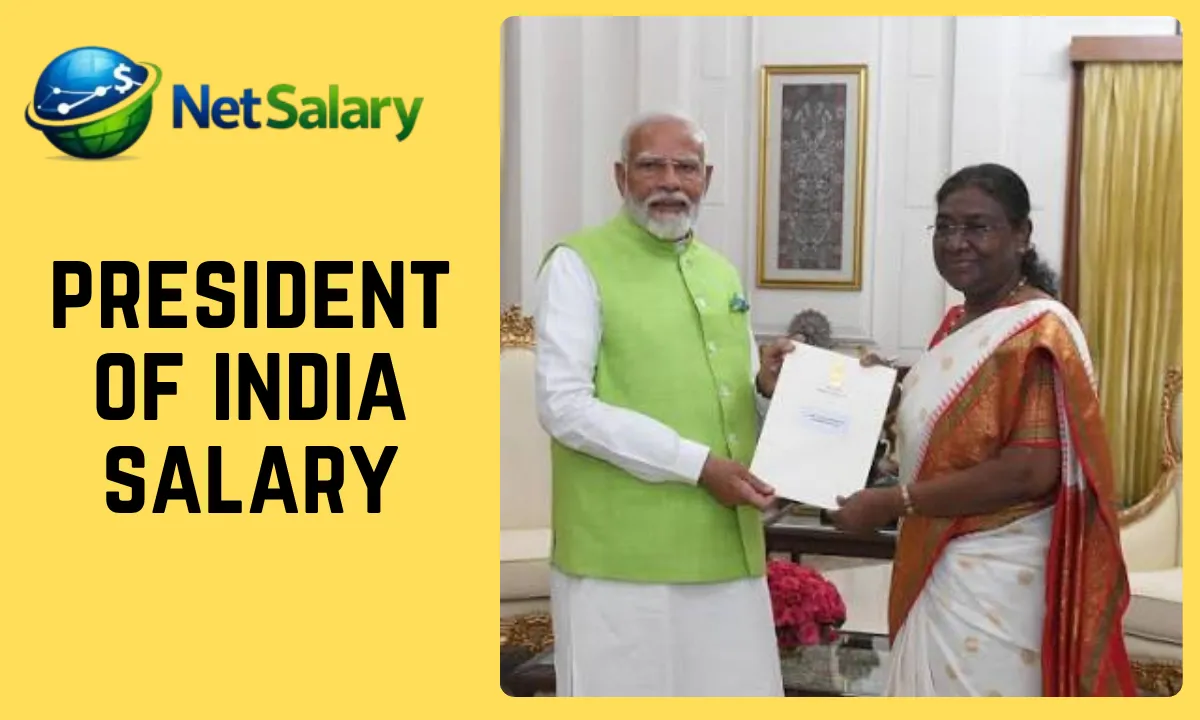
The President of India holds the highest constitutional office in the country, serving as the head of state, the first citizen, and the supreme commander of the armed forces. While the role is largely ceremonial in nature, the office comes with a salary and a set of benefits that reflect its stature. This article lays out everything worth knowing about the President’s salary, how it has changed over the decades, what it looks like once broken down monthly and annually, the tax treatment applied to it, the perks that come alongside it, and what happens financially once a President’s term comes to an end.
Who Decides the President’s Salary
The salary and allowances paid to the President are not set arbitrarily. They are governed by the President’s Emoluments and Pension Act, 1951, a law passed by Parliament that lays out the pay, allowances, and pension due to the holder of this office. Since Parliament has the authority to revise this Act, any change to the President’s salary requires legislative approval, typically introduced and passed alongside the Union Budget.
Current Salary of the President of India
As of 2026, the President of India draws a monthly salary of Rs. 5,00,000. On an annual basis, this works out to Rs. 60,00,000. This figure has remained unchanged since it was last revised, and it stands as one of the highest salaries drawn by any constitutional authority in the country.
| Component | Amount |
|---|---|
| Monthly Salary | Rs. 5,00,000 |
| Annual Salary | Rs. 60,00,000 |
| Salary Basis | Fixed under the President’s Emoluments and Pension Act, 1951 |
| Tax Status | Exempt from income tax |
How the Salary Has Changed Over Time
The President’s pay has not always stood at this level. For much of the recent past, the monthly salary was fixed at Rs. 1,50,000. This changed with the Union Budget of 2017, when the government revised the figure upward to Rs. 5,00,000 a month, a move intended to bring the pay of the office in line with the dignity and responsibility attached to the constitutional post. Since that revision, the monthly figure of Rs. 5,00,000 has held steady through subsequent years, including into 2026.
Tax Treatment of the President’s Salary
One point that often surprises people is that the President’s salary is exempt from income tax. Unlike most other government office holders, whose salaries are taxable under standard income tax provisions, the emoluments paid to the President are specifically excluded from taxation. This means the entire Rs. 5,00,000 drawn each month is retained without any deduction on account of income tax.
Allowances and Official Perks
Salary is only one part of the overall compensation attached to the President’s office. A wide range of allowances and facilities are provided on top of the monthly pay, covering nearly every aspect of daily life and official duty.
- Official Residence: The President resides at Rashtrapati Bhavan in New Delhi, one of the largest presidential residences in the world, spread across a vast area and containing hundreds of rooms used for both residential and ceremonial purposes
- Medical Facilities: Free and comprehensive medical treatment is provided for the President and their family, covering both routine care and specialized treatment when required
- Official Travel: All travel undertaken in connection with official duties, whether within India or abroad, is arranged and funded by the government, including the use of aircraft and other transport as needed
- Security Cover: The President receives the highest level of security cover available in the country, provided round the clock by dedicated protection units
- Staff and Administrative Support: A full secretarial and administrative staff supports the day to day functioning of the President’s office, handling correspondence, scheduling, and the operational needs of Rashtrapati Bhavan
- Entertainment and Hospitality Allowance: A separate allowance is set aside to cover the costs of hosting dignitaries, state functions, and official ceremonies held at Rashtrapati Bhavan
Benefits After Retirement
Once a President’s term concludes, whether through completion of the term or otherwise, a defined set of post retirement benefits comes into effect under the same Act.
- Pension: A former President is entitled to a lifetime pension. Figures reported for this pension vary, with some sources placing it at around Rs. 1.5 lakh per month, while others describe it as being calculated at 50 percent of the President’s monthly salary at the time of leaving office, which would place it closer to Rs. 2.5 lakh per month. The exact figure depends on the applicable provisions in force at the time and is charged to the Consolidated Fund of India
- Furnished Residence: A rent free bungalow is provided for the lifetime use of the former President
- Secretarial Staff: Continued administrative support is made available even after the term ends
- Medical Facilities: Free medical treatment continues to be available for life
- Travel Benefits: Certain travel allowances and facilities continue to be extended to former Presidents
If an individual served as Vice President before becoming President, separate pension benefits tied to the Vice President’s post are not claimed in addition to the President’s pension, since the higher office supersedes the lower one for pension purposes.
Comparison With Other Constitutional Posts in India
To place the President’s salary in context, it helps to compare it with other high constitutional offices in the country.
| Post | Approximate Monthly Salary |
|---|---|
| President of India | Rs. 5,00,000 |
| Vice President of India | Rs. 4,00,000 |
| Prime Minister of India | Approximately Rs. 2,80,000 (including basic pay and allowances) |
Interestingly, the President’s official salary is higher than that of the Prime Minister, even though the Prime Minister holds the executive authority to run the government on a day to day basis. This reflects the ceremonial and constitutional weight attached to the presidency rather than any measure of executive power.
Comparison With Salaries of World Leaders
When placed alongside the compensation drawn by heads of state in other major countries, the President of India’s salary is on the lower end. The salaries drawn by the President of the United States and the Prime Minister of the United Kingdom, for instance, are considerably higher when converted to comparable currency terms. This gap is often pointed out in discussions about the office, though it is generally accepted that the extensive perks, security, and lifetime post retirement benefits attached to the Indian presidency go a long way in offsetting the comparatively modest headline salary figure.
Current Officeholder
As of 2026, Smt. Droupadi Murmu holds the office of President of India, having taken oath as the 15th President of the country on 25 July 2022. She is the first tribal woman to hold this position and the second woman President in India’s history.
Key Facts at a Glance
- The President’s salary is fixed under the President’s Emoluments and Pension Act, 1951
- The current monthly salary stands at Rs. 5,00,000, translating to Rs. 60,00,000 annually
- The salary was last significantly revised in the 2017 Union Budget, up from Rs. 1,50,000 per month
- The salary is exempt from income tax
- Rashtrapati Bhavan serves as the official residence during the term
- A lifetime pension, along with a rent free residence, medical care, staff support, and travel benefits, continues after the term ends
- Any revision to the salary requires approval from Parliament
Conclusion
The salary of the President of India, currently fixed at Rs. 5,00,000 per month or Rs. 60,00,000 annually, represents far more than a simple figure on a payslip. It is backed by a wide network of allowances, facilities, and lifetime post retirement benefits that together reflect the significance of the office. While the headline number may appear modest when compared with the earnings of heads of state in some other nations, the complete package, tax exemption included, positions the President’s compensation as one of the most comprehensive and well supported in Indian public life.
Frequently Asked Questions
What is the current salary of the President of India?
The President of India draws a monthly salary of Rs. 5,00,000, which comes to Rs. 60,00,000 annually.
Is the President’s salary taxable?
No. The salary drawn by the President of India is exempt from income tax under the applicable provisions.
When was the President’s salary last revised?
The salary was last revised in the 2017 Union Budget, when it was raised from Rs. 1,50,000 per month to the current Rs. 5,00,000 per month.
What law governs the President’s salary and benefits?
The President’s Emoluments and Pension Act, 1951, governs the salary, allowances, and pension of the President of India, and any change to these figures requires parliamentary approval.
What pension does a former President receive?
A former President receives a lifetime pension, with reported figures ranging from around Rs. 1.5 lakh to Rs. 2.5 lakh per month depending on the source, along with a rent free residence, medical care, staff support, and travel benefits.
Does the President get a free residence?
Yes. During the term, the President resides at Rashtrapati Bhavan in New Delhi, and a rent free bungalow is provided for life after the term ends.
How does the President’s salary compare with the Prime Minister’s salary?
The President’s monthly salary of Rs. 5,00,000 is higher than the Prime Minister’s salary, which is estimated at around Rs. 2,80,000 per month including allowances.
Who is the current President of India?
Smt. Droupadi Murmu is the current President of India, having taken oath as the 15th President on 25 July 2022.
Is the President of India’s salary the highest among world leaders?
No. When compared with the salaries of leaders such as the President of the United States or the Prime Minister of the United Kingdom, the Indian President’s salary is on the lower end, although it comes with extensive non salary benefits.
Also check: Delhi Police SI Salary | 12 LPA In Hand Salary | 11.5 LPA In Hand Salary | I’m 25 and Earning ₹30K a Month How Should I Start Investing for Long-Term Growth? | 11 LPA In Hand Salary